Saturday, 30 July 2011
Pia Tafdrup's poem for Norway
Seven Dresses for Visibility
by Pia Tafdrup
I am sewing a dress that can be worn
proudly by one who is born with
an expectant spark in the heart’s vessels,
it will perfectly fit large and small,
is spun strong by the bow of the rain
it can be enjoyed a whole life long,
if the cloth is looked after well.
I am sewing a dress that can be worn
silently by new victims of fear,
it can fit large and small,
does not hide vulnerability
as droves of birds are hunted
out of the tree's dense crown,
the fabric flutters in the wind.
I am sewing a dress that can be worn
lightly by new victims of hate,
it is coloured red by blood
and has thunder-black borders,
it can fit large and small,
those who least of all will think
that one should change before the night.
I am sewing a dress that can be worn
by the victims of a cold cynicism
it can fit large and small,
its crazy fabric is made
of fire no downpour will quench,
it will be a reminder that the earth
may open up at any time at all.
I am sewing a dress that can cover
dried blood on the victims of death,
it can hide large and small,
it is shaped by the deep furrows
of tears across the cheek,
the cloth matches the walls of the dark,
the peace in each grave on the planet.
I am sewing a dress that can be worn
in a misty haze of sorrow’s
victims, designed for relatives
and friends of the deceased,
it can fit large and small,
anger’s first light is visible
between lead-grey threads of pain.
I am sewing the dress that can be worn
securely by one who knows hope,
woven in are the laughter of friends,
quiet tears of joy, the desire
to wake up in spite
of life the disaster took
– it reflects the rays of the sun.
translated from the Danish by David McDuff
Syv kjoler for synlighheden
Jeg syr en kjole, som kan bæres
stolt af den, der fødes med
forventningsgnist i hjertets kar,
den passer fuldendt stor og lille,
spindes stærkt af regnens bue,
den kan nydes hele livet,
hvis der værnes godt om klædet.
Jeg syr en kjole, som kan bæres
tyst af frygtens nye offer,
den kan passe stor og lille,
skjuler ikke sårbarhed,
som flokkevis af fugle jages
ud af træets tætte krone,
flagrer stoffet op i vinden.
Jeg syr en kjole, som kan bæres
let af hadets nye offer,
den er farvet rød af blodet
og har tordensorte kanter,
den kan passe stor og lille,
den, der mindst af alt vil tro,
der skulle skiftes tøj før natten.
Jeg syr en kjole, som kan bæres
af en kold kynismes offer,
den kan passe stor og lille,
kjolens vanvidsstof er gjort
af ild, som ingen skylregn slukker,
den skal minde om, at jorden
når som helst kan åbne sig.
Jeg syr en kjole, som kan dække
størknet blod på dødens offer,
den kan skjule stor og lille,
den er formet efter grådens
dybe furer over kinden,
klædet matcher mørkets vægge,
freden i hver grav på kloden.
Jeg syr en kjole, som kan bæres
i en tågedøs af sorgens
offer, viet til en slægtning
og til venner af den døde,
den kan passe stor og lille,
vredens første lys er synligt
mellem blygrå smertetråde.
Jeg syr på kjolen, som kan bæres
trygt af den, der kender håbet,
vævet ind er venners latter,
stille glædestårer, lysten
til at vågne op på trods
af liv, som katastrofen tog
– den reflekterer solens stråler.
Pia Tafdrup is one of the major contemporary Danish poets working today, and her work has been translated into more than thirty languages. She is the author of more than twenty books, several of which have been translated into English, and the recipient of numerous awards – including Scandinavia's prestigious Nordic Council Literature Prize for Queen's Gate (1999), which was published in David McDuff's English translation by Bloodaxe Books in 2001. Also in 2001, she was appointed a Knight of the Order of Dannebrog, and in 2006 she received the Nordic Prize from the Swedish Academy. Her latest work translated into English is Tarkovsky's Horses and other poems (Bloodaxe Books, 2010), combining The Whales in Paris (2002) and Tarkovsky's Horses (2006).
She wrote 'Seven Dresses for Visibility' after the July 22 tragedy in Norway. It was published in Politiken (Denmark’s most important newspaper), was read on Danish radio, and will be published in the Swedish newspaper Dagens Nyheter. This English translation by David McDuff was first published by World Literature Today, and then reprinted in The Times and on Nordic Voices. Many thanks to the poet and translator for their permission to reprint it here.
Thursday, 28 July 2011
Tomas Tranströmer at 80
Sweden's greatest living poet, Tomas Tranströmer, celebrated his 80th birthday in April of this year. To mark the occasion, Bloodaxe Books published a new expanded edition of his New Collected Poems, the award-winning definitive translation of all his poetry by Robin Fulton.
In Sweden, Daphne Records released Dagsmeja: Emma Tranströmer sjunger Tomas Tranströmer (Noon Thaw: Emma Tranströmer sings Tomas Tranströmer). This is a recording of settings of eighteen poems by Tranströmer performed by his daughter Emma Tranströmer, pianist Andreas Kreuger, guitarist David Härenstam and violinist Bernt Lysell. The main musical emphasis is on Fredrik Jakobsson, an outstandingly talented Swedish composer largely unknown to the general public. Emma also includes a couple of songs by the more established Maurice Karkoff, who recently completed two new Tranströmer settings, plus a few songs by Håkan Parkman, who died in a tragic drowning accident in August 1988, aged only 33.
The project began, Emma says, with the Dagsmeja concert performance at the Gävle Concert Hall in 2007. 'Dagsmeja is a tribute to my father, above all perhaps as a guide in the art of humane living, but also as reflected through his own poetry. Pianist Andreas Kreuger and I had a labour of love in finding the very music which felt perfectly fitting for the occasion.'
Three of the poems they chose for the concert and CD are printed below, with the translations by Robin Fulton from Tranströmer's New Collected Poems which accompany them in the CD booklet – this includes all the poems in the Swedish original with Fulton's translations, along with accounts of the project by Emma Tranströmer and by scholar Niklas Schiöler (who contributes a fascinating piece called 'Reading is listening' on Tranströmer and music). The CD cover shows J.M.W. Turner's painting Rain, Steam and Speed – The Great Western Railway (1844), which hangs in the National Gallery in London. Tranströmer's poem 'A Sketch from 1844' pictures Turner making a sketch possibly featuring the same train.
A Sketch from 1844
William Turner’s face is weather-brown
he has set up his easel far out among the breakers.
We follow the silver-green cable down in the depths.
He wades out in the shelving kingdom of death.
A train rolls in. Come closer.
Rain, rain travels over us.
En skiss från 1844
William Turners ansikte är brunt av väder
han har sitt staffli längst ute bland bränningarna.
Vi följer den silvergröna kabeln ner i djupen.
Han vadar ut i det långgrunda dödsriket.
Ett tåg rullar in. Kom närmare.
Regn, regn färdas över oss.
[from The Wild-Market Square, 1983]
*
Från mars -79
Trött på alla som kommer med ord, ord men inget språk
for jag till den snötäckta ön.
Det vilda har inga ord
De oskrivna sidorna breder ut sig åt alla håll!
Jag stöter på spåren av rådjursklövar i snön.
Språk men inga ord.
From March 1979
Weary of all who come with words, words but no language
I make my way to the snow-covered island.
The untamed has no words.
The unwritten pages spread out on every side!
I come upon the tracks of deer’s hooves in the snow.
Language but no words.
[from The Wild-Market Square, 1983]
*
April och tystnad
Våren ligger öde.
Det sammetsmörka diket
krälar vid min sida
utan spegelbilder
Det enda som lyser
är gula blommor.
Jag bärs i min skugga
som en fiol
i sin svarta låda.
Det enda jag vill säga
glimmar utom räckhåll
som silvret
hos pantlånaren.
April and Silence
Spring lies desolate.
The velvet-dark ditch
crawls by my side
without reflections.
The only thing that shines
is yellow flowers.
I am carried in my shadow
like a violin
in its black case.
The only thing I want to say
glitters out of reach
like the silver
in a pawnbroker’s.
[from The Sad Gondola, 1996]
About Tomas Tranströmer
Tomas Tranströmer has been called a ‘buzzard poet’ (by Lasse Söderberg) because his haunting, visionary poetry shows the world from a height, in a mystic dimension, but brings every detail of the natural world into sharp focus. His poems are often explorations of the borderland between sleep and waking, between the conscious and unconscious states.
He is Scandinavia’s best-known and most influential contemporary poet. His books sell thousands of copies in Sweden, and his work has been translated into 50 languages, with substantial or complete editions of his work published in 19 languages.
Tranströmer was born in 1931 in Stockholm, where he grew up, but spent many long summers on the island of Runmarö in the nearby archipelago, evoking that landscape in his early work, which draws on the aesthetic tradition of Swedish nature poetry. His later poetry is more personal, open and relaxed, often reflecting his broad interests: travel, music, painting, archaeology and natural sciences.
Many of his poems use compressed description and concentrate on a single distinct image as a catalyst for psychological insight and metaphysical interpretation. This acts as a meeting-point or threshold between conflicting elements or forces: sea and land, man and nature, freedom and control. His translator Robin Fulton has noted how such images ‘leap out from the page, so that the first-time reader or listener has the feeling of being given something very tangible, at once’, which has made Tranströmer’s poetry amenable to translation into other languages. But while acknowledging Tranströmer’s view that ‘a poem can exist beneath or prior to a particular language and can therefore emerge in any number of tongues’, Fulton maintains that ‘the best versions of his poems are those he made himself in his own language’. Yet such is the power of Tranströmer’s ‘deep image’ poetry that several American poets have been influenced by his work, through translations by Robert Bly in particular.
Tranströmer started writing poetry while at the oppressive Södra Latin Grammar School (its atmosphere caught by Ingmar Bergman in Alf Sjöberg’s Frenzy, which was filmed there, the young Tomas amongst the pupils). But he was devouring books on all subjects, especially geography, with daily visits to the local library, where he worked his way through most of the non-fiction shelves. However, this bookish adolescence was shadowed by the war, by his parents’ divorce and the absence of his father, and at 15 he experienced a winter of psychological crisis (described in ‘Exorcism’, printed below). He published his first collection, 17 Poems, in 1954, at the age of 23.
After studying psychology at the University of Stockholm, he worked at its Psychotechnological Institute, and in 1960 became a psychologist at Roxtuna, a young offenders institution. From the mid-1960s he divided his time between his writing and his work as a psychologist, and in 1965 moved with his family to Västerås, where he spent the rest of his working life.
Like the scientist-poet Miroslav Holub, Tranströmer sees no division between his own two fields, poetry and psychology. In an interview in 1973 he responded to Gunnar Harding’s question about how his writing related to his work as a psychologist:
'I believe there is a very close connection, though it can’t be seen. Everything one writes is an expression of a gathered experience. And the problems one meets in the world at large are present to a very great extent in what I write, though it doesn’t always show directly. But it’s close to hand, all the time.'
In 1990, a year after the publication of his tenth book of poems, Tranströmer suffered a stroke, which deprived him of most of his speech and partly inhibited movement on his right-hand side. Swedish composers have since written several left-hand piano pieces especially for him to play.
Since his stroke, he has published a short book of ‘autobiographical chapters’, Memories Look at Me (1993), and a new collection, The Sad Gondola (1996), both included in Robin Fulton’s translation of his New Collected Poems (Bloodaxe Books, 1997), expanded from his 1987 Collected Poems from Bloodaxe. In 2004 he published The Great Enigma, a slim volume containing five short poems and a group of 45 even smaller haiku-type poems. These were added to the New Collected Poems to form Tranströmer’s first collected edition to appear in the States, licensed by Bloodaxe Books to New Directions in 2006 under the title The Great Enigma: New Collected Poems. That edition was published by Bloodaxe Books in the UK as the latest revised and expanded edition of New Collected Poems in 2011.
Tranströmer has also translated other poets into Swedish, including Robert Bly and Hungary’s János Pilinszky. In 1990 he received the Neustadt International Prize for Literature. His other awards include the Bonnier Award for Poetry, Germany’s Petrarch Prize, the Bellman Prize, the Swedish Academy’s Nordic Prize, and the August Prize. In 1997 the city of Västerås established a special Tranströmer Prize. In 2007, he received a special Lifetime Recognition Award given by the trustees of the Griffin Trust for Excellence in Poetry, which also awards the annual Griffin Poetry Prize.
Tranströmer has been tipped to win the Nobel Prize in Literature on a number of occasions, most recently in 2010, as the Guardian reported, only for Mario Vargas Llosa to pip him at the post.
Robin Fulton has worked with Tranströmer on each of his collections as they have been published over many years, and his award-winning translation New Collected Poems is the most authoritative and comprehensive edition of his poetry published anywhere. It received a highly appreciative review from Paul Batchelor in The Guardian in June: 'Fulton is to be applauded for bringing into English a unique sensibility, a haunting voice, and images of such incisive clarity that they can permanently alter your perceptions.' To read the whole review, click on this link.
As well as complete translations of all his poetry collections, Tomas Tranströmer's New Collected Poems includes his 1993 prose memoir, Memories Look at Me, from which this autobiographical sketch is taken:
Exorcism
During the winter when I was 15 I was afflicted by a severe form of anxiety. I was trapped by a searchlight which radiated not light but darkness. I was caught each afternoon as twilight fell and not released from that terrible grip until next day dawned. I slept very little, I sat up in bed, usually with a thick book before me. I read several thick books in that period but I can’t say I really read them for they left no trace in my memory. The books were a pretext for leaving the light on.
It began in late autumn. One evening I’d gone to the cinema and seen Squandered Days, a film about an alcoholic. He finishes in a state of delirium – a harrowing sequence which today I would perhaps find rather childish. But not then.
As I lay down to sleep I reran the film in my mind’s eye, as one does after being at the cinema.
Suddenly the atmosphere in the room was tense with dread. Something took total possession of me. Suddenly my body started shaking, especially my legs. I was a clockwork toy which had been wound up and now rattled and jumped helplessly. The cramps were quite beyond the control of my will, I had never experienced anything like this. I screamed for help and Mother came through. Gradually the cramps ebbed out. And did not return. But my dread intensified and from dusk to dawn would not leave me alone. The feeling that dominated my nights was the terror which Fritz Lang came near to catching in certain scenes of Dr Mabuse’s Testament, especially the opening scene – a print works where someone hides while the machines and everything else vibrate. I recognised myself in this immediately, although my nights were quieter.
The most important element in my existence was Illness. The world was a vast hospital. I saw before me human beings deformed in body and in soul. The light burned and tried to hold off the terrible faces but sometimes I would doze off, my eyelids would close, and the terrible faces would suddenly be closing in on me.
It all happened in silence, yet within the silence voices were endlessly busy. The wallpaper pattern made faces. Now and then the silence would be broken by a ticking in the walls. Produced by what? By whom? By me? The walls crackled because my sick thoughts wanted them to. So much the worse… Was I insane? Almost.
I was afraid of drifting into madness but in general I did not feel threatened by any kind of illness – it was scarcely a case of hypochondria – but it was rather the total power of illness that aroused terror. As in a film where an innocuous apartment interior changes its character entirely when ominous music is heard, I now experienced the outer world quite differently because it included my awareness of that domination wielded by sickness. A few years previously I had wanted to be an explorer. Now I had pushed my way into an unknown country where I had never wanted to be. I had discovered an evil power. Or rather, the evil power had discovered me.
I read recently about some teenagers who lost all their joy in living because they became obsessed with the idea that AIDS had taken over the world. They would have understood me.
Mother had witnessed the cramps I suffered that evening in late autumn as my crisis began. But after that she had to be held outside it all. Everyone had to be excluded, what was going on was just too terrible to be talked about. I was surrounded by ghosts. I myself was a ghost. A ghost that walked to school every morning and sat through the lessons without revealing its secret. School had become a breathing space, my dread wasn’t the same there. It was my private life that was haunted. Everything was upside down.
At that time I was sceptical towards all forms of religion and I certainly said no prayers. If the crisis had arisen a few years later I would have been able to experience it as a revelation, something that would rouse me, like Siddhartha’s four encounters (with an old person, with a sick person, with a corpse, and with a begging monk). I would have managed to feel a little more sympathy for and a little less dread of the deformed and the sick who invaded my nocturnal consciousness. But then, caught in my dread, religiously coloured explanations were not available to me. No prayers, but attempts at exorcism by way of music. It was during that period I began to hammer at the piano in earnest.
And all the time I was growing. At the beginning of that autumn term I was one of the smallest in the class, but by its end I was one of the tallest. As if the dread I lived in were a kind of fertiliser helping the plant to shoot up.
Winter moved towards its end and the days lengthened. Now, miraculously, the darkness in my own life withdrew. It happened gradually and I was slow in realising fully what was happening. One spring evening I discovered that all my terrors were now marginal. I sat with some friends philosophising and smoking cigars. It was time to walk home through the pale spring night and I had no feeling at all of terrors waiting for me at home.
Still, it is something I have taken part in. Possibly my most important experience. But it came to an end. I thought it was Inferno but it was Purgatory.
*
All the English translations of poetry and prose by Tomas Tranströmer in this blog posting are by Robin Fulton from New Collected Poems (Bloodaxe Books, 2011).
Monday, 25 July 2011
Basil Bunting's advice to young poets
Basil Bunting beside the River Rawthey by Jonathan Williams (1980)
Basil Bunting was asked so many times for advice by young poets that he had a postcard printed with his key points:
I SUGGEST
1. Compose aloud; poetry is a sound.
2. Vary rhythm enough to stir the emotion you want but not so as to lose impetus.
3. Use spoken words and syntax.
4. Fear adjectives; they bleed nouns. Hate the passive.
5. Jettison ornament gaily but keep shape
Put your poem away till you forget it, then:
6. Cut out every word you dare.
7. Do it again a week later, and again.
Never explain - your reader is as smart as you.
Basil Bunting reads from Briggflatts
This video features four short extracts of Basil Bunting reading from his long poem Briggflatts (not in order), from Peter Bell's 1982 film portrait of Bunting, included on a DVD issued with the new Bloodaxe edition of Briggflatts (which also has a CD of an audio recording Bunting made of the whole of Briggflatts in 1967). Peter Bell’s superb film Basil Bunting: An introduction to the work of a poet was made by Northeast Films and first shown on Channel Four in 1982. The first two extracts here follow the sequence used in the film, not that of the poem itself (the second extract is the opening of the poem: 'Brag, sweet tenor bull...'). Most of the film was shot around (and in) Brigflatts meeting house near Sedbergh, Cumbria, and at Greystead Cottage in Northumberland’s Tarset valley, where Bunting lived from 1981 to 1984. The film is from the Arts Council England film collection, and is copyright Arts Council of Great Britain 1982. (Note: Briggflatts the poem has two gs, Brigflatts the place has one.) To order the new Bloodaxe edition of Briggflatts with free DVD and CD, click on this link to Amazon.co.uk
Basil Bunting at Brigflatts by Derek Smith (1983)
Basil Bunting reunited at Brigflatts with his childhood sweetheart Peggy Mullett (to whom Briggflatts is dedicated), after 50 years. Picture by Jonathan Williams.
Sunday, 24 July 2011
Newcastle/Bloodaxe Poetry Lectures
In this innovative series of public lectures at Newcastle University, leading contemporary poets speak about the craft and practice of poetry to audiences drawn from both the city and the university. The lectures are then published in book form by Bloodaxe, giving readers everywhere the opportunity to learn what the poets themselves think about their own subject. Bloodaxe Books has worked with Newcastle University for the past ten years on a series of publications linked not only to the lecture series but also to poetry conferences and other educational projects.
One of our readers, José Maria Prieto, wanting to order books from Spain, has asked if there is a list of books in the Newcastle/Bloodaxe poetry series. These are listed below: clicking on the titles will take you to a description of the book on the Bloodaxe Books website; click on AMAZON and that will take you straight to the Amazon ordering page for that title. NBPL indicates Newcastle/Bloodaxe Poetry Lectures. Publication of Jo Shapcott's book of lectures, The Transformers, has had to be delayed. The next titles in the series will be an anthology portrait of Britain by black and Asian poets called Out of Bounds, edited by Jackie Kay, James Procter and Gemma Robinson (March 2012), followed by Sean O'Brien's Newcastle/Bloodaxe Poetry Lectures, which he will be delivering in autumn 2011 with publication in 2012.
1: Linda Anderson & Jo Shapcott (eds.): Elizabeth Bishop: Poet of the Periphery (2002). AMAZON
2: David Constantine: A Living Language. NBPL (2004). AMAZON
3: Julia Darling & Cynthia Fuller (eds.) The Poetry Cure (2005).
AMAZON
4: Jo Shapcott: The Transformers. NBPL (delayed).
5: Carol Rumens: Self into Song. NBPL (2007). AMAZON
6: Desmond Graham: Making Poems and Their Meanings. NBPL (2007). AMAZON
7: Jane Hirshfield: Hiddenness, Uncertainty, Surprise: Three Generative Energies of Poetry. NBPL (2008). AMAZON
8: Ruth Padel: Silent Letters of the Alphabet. NBPL (2010). AMAZON
9: George Szirtes: Fortinbras at the Fishhouses: Responsibility, the Iron Curtain and the sense of history as knowledge. NBPL (2010). AMAZON
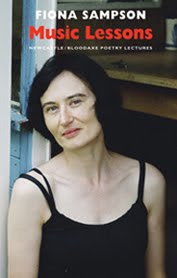
10: Fiona Sampson: Music Lessons. NBPL (2011). AMAZON
Friday, 22 July 2011
Clare Pollard reads from Changeling
Clare Pollard reads four poems from her latest Bloodaxe collection Changeling and talks about the book. Steeped in folktale and ballads, Changeling takes on our myths and monsters, from the Pendle witch-trials in 17th-century Lancashire to modern-day London and Iraq. The poems are 'Tam Lin's Wife', 'Pendle', 'The Two Ravens' and 'The Caravan'. Neil Astley filmed Clare Pollard at her home in London in June 2011.
Luljeta Lleshanaku interviewed by S.J. Fowler
Luljeta Lleshanaku was interviewed by S.J. Fowler in 3:AM magazine's Maintenant series
S.J. Fowler writes: 'It is hard to make a case against Luljeta Lleshanaku being the greatest Albanian poet of the modern era. Such is the measure of her work, and her repute across Europe and America. Her poetry reflects her marked humility and reverence for the written word, utterly unique and yet universal in a way that belies the overuse of that concept. Though a child of political exile and marginalization, let alone physical danger, her work remains dignified and singular, and nor does she allow her poetry to be dominated by the issues of her nation, of its politics and history. She is a voice that would be recognized as truly poetic in any language, in any setting and this perhaps her most remarkable achievement. A winner of the International Kristal Vilenica prize (following the likes of Peter Handke, Zbigniew Herbert & Milan Kundera) it is wonderful to announce her first work published in the UK, Haywire: New & Selected Poems, will be released this September with Bloodaxe Books, already a Poetry Book Society Recommended Translation. She will be attending this year’s Aldeburgh Poetry Festival in November. It is honour to introduce the 60th edition of Maintenant, a pioneer of Balkan poetry and a rightfully major figure in the current European poetry landscape.'
3:AM: Albania remains a unique country, both in its language, its culture and to a certain extent, in its isolation. Was there an expectation post 1985 and 1992, that the country would become more integrated and expansive in its actions, and that this might affect the literary culture?
Luljeta Lleshanaku: This is a very good question. I was 17 years old, when they announced the death of the dictator Enver Hoxha. It was April 11th, 1985. I was in high school, and I couldn’t wait to go back home, and celebrate it. I think a lot of people felt in that way. We thought, something was going to happen after it…a positive change…or something. But it was just an illusion; the family Hoxha and the new president Ramiz Alia went on governing with an iron hand…and the restriction was even higher, to try to keep the situation under control. Then we understood that the regime had to resist… The economy was catastrophically failing day after day…and the displeasure was not only political, but economic too. The longer the situation would last, the more dramatic the change of the system would be. In July 1990, around 5000 Albanian people occupied the Western embassies in Tirana: the German, Italian, French embassies. It is still a mystery how they could jump so easily into the yards of diplomatic residences, but for many people is already clear now that everything was projected by the communist government… as a plan to discharge the tension by pushing away the most dangerous part of population, the most rebellious part, those who could be really the first squadron of any movement. The point is this provoked exodus and didn’t calm the situation in Albania, but only increased the tension. I remember that in September 1990, the Secret Service sequestrated my passport, so it was clear that they were not tolerating any resistance and they were resisting in a frightening way…until 1991.
After 1992, Albania was totally exposed to any kind of cultural “attack”, all at once. I remember well the “Beatles” music shouting from radios, second-hand clothes exposed everywhere, cowboy movies, pornographic literature in the street… everything which was forbidden for a long time. The bookshops in Tirana were filled with American and French books, translated and printed in a hurry, in spite of their low technical quality. It was a urgent run towards the world which was refused us for about 47 years.
3:AM: The legacy of Albanian writers and poets is considerable in places. Ismail Kadare is obviously a world reputed writer. Yet it would not be an exaggeration to consider you the most reputed poet in Albania’s history since independence in 1912…
I was lucky to have the chances of publication abroad, in the US at first, and then in Italy, Austria, Poland and the UK in September. But I don’t want to be unfair: nobody can imagine what would be the Albanian literature situation… if we would ignore for a moment all the political repression and the fact that Albanian language is a small unique language. In such conditions, the promotion of Albanian literature in the world is an indicator of talent as much as a question of “accident”. But it was another writer of the 30s, an Albanian Franciscan friar who was the first Albanian nominated writer for Nobel Prize… His name was Gjergj Fishta, he was one of the anathematised writers by the communist regime, mostly because of his religious Catholic background.
3:AM: Has there arisen a stereotype because of the writing of the likes of Kadare that Albania is somehow inflected with an “old world” mentality - the kanun, the blood feud etc…that might not perhaps be accurate?
LL: It was a smart gesture of Kadare to avoid sometimes the extreme propagandistic reality of Communist Albania, through creating stories about Albanian myths, habits and all the spiritual infrastructure of the past. Blood feud was a part of “Kanun”- the medievalist code of self-governing in Albania. This stereotype is created by the anthropological perspective of foreign visitors and writers in the end of 19th century and the beginning of 20th century like Edith Durham and Rose Lane and it was fortified and mystified by the long time isolation of Albania to the world. It is true that there was a metamorphosis, a refreshing of the phenomenon after the 90s…in the conditions of a legal vacuum and the political mess of Albania.
Also the Albanian cinema after the 90s “played” with this “blood feud”, but mostly for sensational reasons. To identify Albania with blood feud is like identifying USA with some vandalistic acts in schools, or like identifying Buenos Aires with those wallet robbers in the street, experienced by the tourists. I personally am surprised when I am faced with such a topic: is blood feud really our identifying culture element?! Perhaps it is, but not in the wide dimensions it is perceived from abroad.
3:AM: The poets who wrote in exile and underground under Hoxha have left a considerable legacy, perhaps Arshi Pipa most of all. What is his legacy with contemporary Albanian poets?
LL: I think…the ideology could influence more the poetry than prose. The subjectivity was the target of ideology, considered the most dangerous thing. All the strategy aimed to flatten the individual voices and to encourage thinking in a group and for a group. That’s the way the Mayakovskian Futurism was easily embraced in the Albanian poetry of sixties and seventies. The collective awareness, “muscular” reality, the optimistic point view of life were a part of what was called “romanticist soc-realism”. The image of construction of a country in construction, and a new mentality of peoples who have no time to worry about “small things” was predominant. I don’t think this chapter is going to be interesting anymore for the new generations except as some stylistic exercise. But, there are still some poems which could survive due to beautiful metaphors or the lyrical moment they capture.
The other literature is the “underground” literature and the literature of exile. The “underground” literature-the literature of prison or the hidden literature – perhaps didn’t have the epochal power of Aleksandr Solzhenitsyn or Mandelstam or Brodsky’s work, but at least it has a testifying value of the real Albania. Perhaps…because of being published later, after 1990, it couldn’t affect the reader as is it could’ve done in the right moment. Let’s remember the fact that it was impossible to create some literary groups in Albania, as in some other countries of Eastern Europe. The grouping and the solitude were both considered dangerous enough.
3:AM: The Albanian language itself is very unique, does it lend itself to poetic expression?
LL: It is always interesting to hear the comments about Albanian language, when I give readings in foreign countries. They say 'it is a beautiful language!' Some perceive it as Italian…some as Slavic… some even can’t indentify the similarity. I think Albanian language has the dolcezza of Latin…but enamelled with the toughness of Balkan temperament. It is a language rich with natural sounds of onomatopoeic words. It is very interesting making an anatomy of languages to understand the people: the Albanian language, in my opinion, created its own code of communicating with nature, perhaps as the only way to survive as a verbal language (only) for centuries. Albanian lexicon suggests a high diversity of dialectic forms. But, sometimes I feel that my poems sound better in English, for example, than in my language. Why? The long words…especially the verbs, give some solemnity to the poem, appropriate for a philosophical or rhetorical poem. But, for an imagistic poem like mine, the short words and the simple grammatical forms of English are better. The length of words in English corresponds with the speed of visuality, of observation and thoughts. Perhaps I look a bit crazy saying it but I always had the impression, that there is a parasite time between one image and the other, when the language can’t catch the rhythm of the imagination. So, for example, you can enjoy a rhetoric poem of Borges in Spanish… full of 'e' and 'rr', and see how the sound opens a parallel horizon before you. But, you can’t say that about a poem of Simic for example, in any language it will be offered.
3:AM: Your work maintains much of the elegance of the great post-Second World War European tradition, it evokes the likes of Herbert, Amichai, Pagis, Cassian. Perhaps you share something of their deftness, their care, their sense of responsibility, as poets. Do you think is true?
LL: I would like it to be true. I like Herbert, and I adore Amichai. For the first time I read his poems around ten years ago. It is not an accident I would have something similar with him: the first, because he is my favourite poet. And the second: we both belong to countries who have suffered greatly. What is in common? I think he dials into the real world, real history and the collective ego that dominates the individual ego. He never speaks about himself, even when he pretends to do so. His observation exceeds the white circle of private life. And especially there is always a “why” in his air, something which asks a response in history, and its rotation. And he always gives a response, the best artistic solution, through metaphors, through creating parallel realities. Any other solution is more arbitrary. He is from Israel, the motherland of metaphor (let’s remember the way God communicated with human beings). And…it was not difficult for a person “infected” with life like him, to create such amazing metaphors. He has such a rich life: World War II, Holocaust, the life in New Israel… Perhaps, the only way a poet can reorganise all this chaotic life, is making a system from it. And metaphor is the key. Metaphor became an instinct for him.
I saw a lot of suffering around and the question “why” became an instinct for me too. There comes a moment when I can’t wait out the destruction to understand the “why”. I admire his sensitivity about the world. His observation is always the observation of “the edge”, clear, like being in the last day of his life. Amichai always leaves me the impression of a full room, where there is no place for fighting, resisting or quarreling.
3:AM: Your work appears very fluid, it seems to be very descriptive, working at images, very carefully. How do you begin to write? Do you set yourself time aside to do so, or follow moments when you feel you must?
LL: Strangely I was a hyperactive and very moody child. My mother told me I used to speak regularly during the sleep, except when sleep-walking (somnambulism). I began writing when I was eleven years old. My first poem was a question of “honour”: I was asked to recite a poem, when I didn’t know any poems by heart. I never remember poems by heart. I don’t remember even my cellular phone number by heart. I have difficulty learning by heart; I’ve always had. So, in such conditions I had to improvise something, which sounded like a poem.
Then, (God knows why…) I went on writing humorous poems, and I read them in those little boring parties in high school. Perhaps I needed attention, and asked it in every way possible. I remember that I complicated the relations with my teachers just because of those jeering verses. But at least… I could see the others laughing and I laughed myself, and that was enough for a while.
The other side of my personality was a kind of melancholy which I never understood where it came from. I didn’t worry so much about the concrete hopeless and poor circumstance; what I worried about was something beyond them. Some existential questions. My advanced imagination encouraged me to see what a child never should see: the end of things. Once, I decided to say them in a loud voice: to write them. So I was around 18 years old, when finally I wrote a poem.
3:AM: You are a poet not directly bound to your nation in your work it seems, you maintain a ambiguity of subject. Do you avoid commentary on your nation in some manner, or do you just write how you wish to write?
LL: You are absolutely right. As I just said, my perspective of thinking didn’t have to do with the things which were before my eyes. Any small town in the world is enough for somebody to understand the rules of the world, the rules of the life. Each community functions as a cell of the world, as a micro-cosmos, programmed with all the virtues and vices, geniality and incapacity, vulnerability and ambitions, aggression and tolerance to create the table of human world. You don’t need the test of all your body’s blood, to examine your genetic code; even a single hair is enough.
As you can see, I am sensitive and instinctively seek protection when hearing about my country, like everybody would do. But, I never was convinced enough that nationality says something more than our common intimate relations. The nationality doesn’t determine who we are, but what we are compromised to do. And I never was interested in that.
And furthermore, I think that if the archetype exists, there is stronger inside me. Some unexplainable melancholies and some strange sensations were always an obstacle to be in my time and in my place. That’s why perhaps my identity is determined by an “anonymous” voice (more than universal), than from an active determined voice.
3:AM: The Vilenica Kristal prize has been awarded to some of the greatest European poets of our age, did it feel vindicating to receive the award?
LL: Oh, yes. It was a beautiful surprise. I didn’t even know they give prizes, and to be sincere, it was a moment when I didn’t get any sense on participating in literary festivals. Until that moment, I was also not sure if the Europeans would like my style of writing, since I was published only in the US. So, it was a test for me, and I was really happy to be the preferred one, even if I had a high temperature that day (39 degrees Celsius) and I wore three blouses and a jacket over each other. And… I really can’t forget how nice the Slovenians were and everything during the festival, the days were curated so carefully, with much elegance. But the prize I am awarded with, was not the International Prize, the “grand prix” of career which went to Claudio Magris, but the Kristal Vilenica Prize, for the best writer participant. And…anyway…it was very competitive. I still remember a Croatian writer who was really excellent…the Bulgarian poet attending… All excellent! Thank you for bringing me these emotions back!
This interview was first published in 3:AM magazine on 9 May 2011. SJ Fowler is a postgraduate student of philosophy at the University of London and a poet. He is also an employee of the British Museum.
Luljeta Lleshanaku belongs to the first “post-totalitarian” generation of Albanian poets. In Haywire she turns to the fallout of her country’s past and its relation to herself and her family. Through intense, powerful lyrics, she explores how these histories intertwine and influence her childhood memories and the retelling of her family’s stories. Sorrow, death, imprisonment, and desire are some of the themes that echo deeply in Lleshanaku’s hauntingly beautiful poems.
She was born in Elbasan, Albania in 1968. Under Enver Hoxha’s Stalinist dictatorship, she grew up under house arrest. Lleshanaku was not permitted to attend college or publish her poetry until the weakening and eventual collapse of the regime in the early 1990s. She later studied Albanian philology at the University of Tirana, and has worked as a schoolteacher, literary magazine editor and journalist. She won the prestigious International Kristal Vilenica Prize in 2009, and has had a teaching post at the University of Iowa and a fellowship from the Black Mountain Institute at the University of Nevada, Las Vegas. She has given readings in America, Europe and in Ireland at the Poetry Now Festival in Dún Laoghaire in 2010. Luljeta Lleshanaku is reading at Aldeburgh Poetry Festival on Sunday 6th November (with Robert Hass and Maurice Riordan) and at London's South Bank Centre on Tuesday 8th November (with Amjad Nasser and Soleïman Adel Guémar).
Haywire: New & Selected Poems (Bloodaxe Books, 2011) is her first British publication, and draws on two editions published in the US by New Directions, Fresco: Selected Poems (2002) and Child of Nature (2010), as well as a selection of newer work. Published in September 2011, it is a Poetry Book Society Recommended Translation. Available now from Amazon.co.uk by clicking on this link.
Click on this link to watch a video of Luljeta Lleshanaku reading four poems, with the texts of the poems below.
Tuesday, 19 July 2011
Brian Turner reads his Iraq War poems
Brian Turner reads six of his Iraq War poems from his Bloodaxe collections Here, Bullet and Phantom Noise: 'Here, Bullet', 'Hwy 1', 'Eulogy', '16 Iraqi Policemen', 'The Inventory from a Year Sleeping with Bullets' and 'At Lowe's Home Improvement Center'. Neil Astley filmed Brian Turner at Ledbury Poetry Festival in July 2011.
Subscribe to:
Posts (Atom)